I'm just one person, just two hands, just one heart. I have everything to offer.


This blog brings together resources and stories for other young caregivers and families dealing with the effects of Alzheimer's and the many OTHER forms of dementia including Dementia with Lewy Bodies, Creutzfeldt-Jakob Disease, Frontal Lobe Dementia, Huntington’s Disease , Parkinson’s Disease, Mild Cognitive Impairment, Wernicke-Korsakoff Syndrome, Mixed Dementia, Normal Pressure Hydrocephalus, Pick’s Disease and Vascular Dementia.


Friday, May 25, 2012

A New Attack on Alzheimer’s

The Obama administration has announced a bold research program to test whether a drug can prevent the onset of Alzheimer’s disease well before any symptoms appear. It is a long shot, but the payoff could be huge.

The prevailing, but not universally accepted, hypothesis is that amyloid plaques in the brain play a major role in causing Alzheimer’s. Crenezumab attacks the formation of such plaques, apparently by binding to amyloid proteins and clearing them from the brain. If the drug fails to work, the trial will probably demolish the amyloid hypothesis and set researchers scrambling to find other targets to attack.
Currently, there is no cure for Alzheimer’s, which steadily robs patients of their memory, followed by full-blown dementia. There is also no diagnostic test to identify who has it, and no treatment to slow patients’ deterioration for more than a few months. 
 
While work continues on those fronts, the new clinical trial will test whether the drug, Crenezumab, made by Genentech, can prevent the disease in a group of people whose genetic heritage guarantees that they will develop it. If the drug successfully prevents the loss of mental capacities as measured by a sensitive new cognitive test there is hope — but no guarantee — that it could do the same for members of the general public. As Pam Belluck described in The Times last week, the trial will focus on members of an extended family in Colombia who carry a rare genetic mutation that causes them to develop Alzheimer’s early in life. They typically experience cognitive impairment at about age 45 and dementia by 51. The trial will also include a smaller number of individuals in the United States with the same genetic mutation. 

Instead of recruiting thousands of volunteers and following them for an extended period as in a customary prevention trial, the researchers in Colombia will give the drug to only 100 people with the early-onset genetic mutation. They will give placebos to another 100 people with the mutation and to 100 family members who do not carry the deadly gene. 

The study will cost more than $100 million and is being financed mostly by Genentech, buttressed by $16 million from the National Institutes of Health and $15 million raised by the Banner Alzheimer’s Institute in Phoenix, which is leading the study. 


A prevention trial of a different drug that was also intended to slow formation of amyloid plaques actually made patients’ symptoms worse, possibly because it interfered with various other proteins needed by the brain. Researchers believe that Crenezumab will be safer and more effective, but again there are no guarantees. The risk is justified given that without the treatment the recipients will inevitably get Alzheimer’s in the prime of their lives. The truly big payoff will come if the drug succeeds in this group and lays the groundwork for preventing or slowing the progress of Alzheimer’s that appears late in life. The researchers will be gathering data on a variety of biomarkers — glucose activity in the brain, shrinkage of the brain, certain proteins in cerebral spinal fluid, for example — to see which if any are related to preventing amyloid plaques and the loss of mental abilities. 

If the drug prevents the deterioration of particular biomarkers and ultimately sustains mental capacity, then the same markers might be useful in identifying and treating older people likely to develop the disease. And federal regulators might be willing to approve other prevention drugs based on their short-term effects on biomarkers, speeding the conduct of clinical trials. 

More than five million Americans currently have Alzheimer’s. Without an effective preventive, the number will rise steadily as the population ages. 

Published: May 20, 2012  by NY Times, Editorial

New Drug Trial Seeks to Stop Alzheimer’s Before It Starts

Brain scans of a member of a Colombian family who has Alzheimer's
In a clinical trial that could lead to treatments that prevent Alzheimer’s, people who are genetically guaranteed to develop the disease — but who do not yet have any symptoms — will for the first time be given a drug intended to stop it, federal officials announced Tuesday.

Experts say the study will be one of the few ever conducted to test prevention treatments for any genetically predestined disease. For Alzheimer’s, the trial is unprecedented, “the first to focus on people who are cognitively normal but at very high risk for Alzheimer’s disease,” said Dr. Francis S. Collins, director of the National Institutes of Health. 

Most participants will come from the world’s largest family to experience Alzheimer’s, an extended clan of 5,000 people who live in Medellín, Colombia, and remote mountain villages outside that city. Family members with a specific genetic mutation begin showing cognitive impairment around age 45, and full dementia around age 51, debilitated in their prime working years as their memories fade and the disease quickly assaults their ability to move, eat, speak and communicate. 

Three hundred family members will participate in the initial trial. Those with the mutation will be years away from symptoms, some as young as 30. 

“Because of this study, we do not feel as alone,” said Gladys Betancur, 39, a family member. Her mother died of Alzheimer’s, three of her siblings already have symptoms, and she had a hysterectomy because of her fears that she has the mutation and would pass it on to her children. “Sometimes we think that life is ending, but now we feel that people are trying to help us.” 

The $100 million study will last five years, but sophisticated tests may indicate in two years whether the drug helps delay memory decline or brain changes, said Dr. Eric M. Reiman, executive director of the Banner Alzheimer’s Institute in Phoenix and a study leader. 

Alzheimer’s experts not involved in the study said that though only a small percentage of people with Alzheimer’s have the genetic early-onset form that affects the Colombian family, the trial was expected to yield information that could apply to millions of people worldwide who will develop more conventional Alzheimer’s. 

“It offers a tremendous opportunity for us to answer a large number of questions, while at the same time offering these people some significant clinical help that otherwise they never would have had,” said Dr. Steven T. DeKosky, an Alzheimer’s researcher who is vice president and dean of the University of Virginia School of Medicine. Dr. DeKosky was part of a large group consulted early on, but is not involved in the study. 

Some 5.4 million Americans have Alzheimer’s, and the numbers are expected to swell as the baby boom generation ages. Dr. Reiman’s team is planning a similar trial for people in the United States considered at increased risk for conventional late-onset Alzheimer’s. The study announced Tuesday will include a small number of Americans with gene mutations guaranteed to cause early-onset Alzheimer’s. 

The drug trial is part of the federal government’s first national plan to address Alzheimer’s, which was unveiled Tuesday by Kathleen Sebelius, the secretary for health and human services. The government took the unusual step of assigning $50 million from the current year’s N.I.H. budget to research considered too promising to wait, including the Colombia trial and a study on whether inhaled insulin can ease mild cognitive impairment, Dr. Collins said. Another $100 million is proposed for 2013, mostly for research, but also for education, caregiver support and data collection. 

Success for the Colombia trial is, of course, no sure thing. Many trials fail, and Alzheimer’s research has so far found no treatment effective for more than several months. But experts say that trying drugs years before symptoms emerge could have greater potential because the brain would not yet be ravaged by the disease. The trial will be financed with $16 million from the National Institutes of Health, $15 million from private donors through the Banner Institute and about $65 million from Genentech, the drug’s American manufacturer. 

The drug, Crenezumab, attacks amyloid plaques in the brain. If it can forestall memory or cognitive problems, scientists will know that prevention or delay is possible and appears to lie in targeting amyloid years before dementia develops. Many, but not all, Alzheimer’s researchers believe amyloid is an underlying cause of Alzheimer’s. 

In 2010, The New York Times reported on the pervasiveness of dementia in this large Colombian family and scientists’ hopes of testing prevention drugs. But persuading pharmaceutical companies to invest took months. There are scientific and ethical issues involved with giving drugs to people who are healthy and people who live in a developing country, some of whom have little education, paltry incomes and longstanding superstitions about the disease they call La Bobera — the foolishness.
“The first thing I did was to ask myself the question, Are we taking advantage of these folks?” said Richard H. Scheller, Genentech’s executive vice president of research and early development. “The answer was clearly no.” 

The risks, he said, are balanced by the fact that if nothing is done, “they’re going to get this terrible, terrible disease for sure.” 

The few trials of prevention therapies — involving ginkgo biloba, women’s hormone replacement treatment and anti-inflammatory drugs — have involved people not guaranteed to get the disease. These therapies either failed or caused adverse side effects. 

Testing drugs on that kind of population takes “too many healthy volunteers, too much money, and too many years,” Dr. Reiman said. 

The Colombian population is ideal because it is large enough to provide solid results, and it is easy to identify whom the disease will strike and when. 

Crenezumab was chosen for the Colombia trial partly because it appears to have no negative side effects, unlike other drugs designed to clear amyloid from the brain, said Dr. Francisco Lopera, a Colombian neurologist who has worked with the family for decades and is a leader of the study. Other anti-amyloid treatments have caused edema in the blood vessels, an imbalance of fluid that can have serious consequences. 

Crenezumab is currently being given in two clinical trials to people with mild to moderate symptoms of dementia in the United States, Canada and Western Europe to see if it can help reduce cognitive decline or amyloid accumulation, according to Genentech. 

In the Colombia study, expected to start early next year, 100 family members with the mutation will receive the drug every two weeks in an injection at a hospital. Another 100 carriers will receive a placebo. And because many people do not want to know if they have the mutation, researchers will include 100 noncarriers in the study; they will receive a placebo. 

Researchers have developed a sophisticated battery of five memory and cognitive tests that have been shown in other studies to detect subtle alterations in recall and thinking ability that usually go unnoticed. Dr. Pierre N. Tariot, director of the Banner Institute and a leader of the study, said the measurements would involve recalling words, naming objects, nonverbal reasoning, remembering time and place, and drawing tests involving copying complex figures. 

Dr. Tariot said researchers would also assess changes in people’s emotional state, “irritability, sadness, crying, anxiety, impulsivity — these are cardinal features of the disease as it emerges.”
The scientists will take physiological measurements, including PET scans that measure amyloid and how glucose is metabolized in the brain, M.R.I. scans that measure whether the brain is shrinking, and cerebral spinal fluid tests that measure amyloid and tau, a protein in dying brain cells. 

If any of these indicators are improved by the drug, Dr. Reiman said, scientists may then be able to treat one of these early physiological changes, just as high blood pressure and cholesterol are treated to prevent heart disease. 

In Medellín, Marcela Agudelo, 17, has Alzheimer’s on both sides of her family because her parents are distant cousins. Marcela watched her maternal grandmother die, and her father, 55, once a vibrant livestock trader, has deteriorated so much that he can no longer walk, talk or laugh. 

With the research, “we have more hope for a cure,” Marcela said, “or at least a better life.” 

Dabrali Jimenez contributed reporting.

Tuesday, May 8, 2012

Early Burdens: Eldercare Falls on Young Shoulders

PHOTO: Suzette Armijo, 30, of Phoenix, right, oversees care of her 86-year-old grandmother, Elizabeth Armijo, left, a retired National Park Service ranger.
Suzette Armijo, 30, of Phoenix, right, oversees care of her 86-year-old grandmother, Elizabeth Armijo, left, a retired National Park Service ranger. (Courtesy Suzette Armijo)
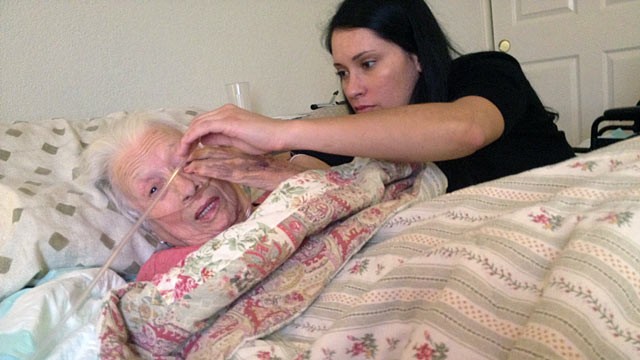
At 30, Suzette Armijo cares for her widowed 86-year-old grandmother, a retired National Park Service ranger in the final stages of Alzheimer's disease, while holding down a fulltime job, a part-time job and raising a 4-year-old son.

"This was nothing that I had planned for," says Armijo, who moved her grandmother Elizabeth Armijo into a nearby six-bed assisted living home because veterans' benefits "wouldn't pay for her to live with me." Still, she says, "I have to do everything for her, aside from her bathing. There's always something new going on with her medically."

Besides her fulltime marketing job with a Phoenix retirement community, Armijo supplements her income with outside consulting because "I do have to pay a portion of Grandma's bills."
 
Although she doesn't know anyone else her age doing what she's doing, she comes to her caregiving out of love for a woman who took care of so many others: "I don't feel torn because I know this is the way my Grandma was," Armijo said Thursday. "She took care of her parents. She took care of my grandfather. She took care of my little brother who had cancer when he was little. I grew up seeing that."

Suzette Armijo is among a generation of young adult caregivers, the majority of whom are women, navigating tough turf without a roadmap. Few of their contemporaries shoulder equivalent responsibilities. Members of the so-called sandwich generation, squeezed by parental caregiving and child-rearing, are a good 20 to 30 years older. As they try to tap into resources to help an ailing grandmother, Mom or Dad, these 20-somethings and 30-somethings are often on a lonely road. Armijo said she's drawn some of her strength from establishing a local young advocates group through the Alzheimer's Association. "You have to find something for yourself, otherwise you lose your mind."

Internet sites like AgingCare.com, which connects caregivers of elderly parents with others, may help this younger caregiving cadre find encouragement, empathy and tips on locating services.

"Other caregivers jump in and help," said Richard Nix, AgingCare.com's 49-year-old executive vice president. The National Stroke Association has launched a free, private Careliving Community with "more than 2,000 caregivers right now," said Taryn Fort, a spokeswoman for the Centennial, Colo.-based organization. Support groups for young caregivers have sprouted within some local chapters of the Alzheimer's Association, said Toni Williams, a spokeswoman for its public policy office in Washington, D.C.
Even the best-laid plans among 20-somethings can be thrown off course by a loved one's catastrophic illness and disability. After graduating from Purdue University in Indiana last May, Lauren Erickson spent six weeks in a competitive pre-medical enrichment program in Cincinnati. In September, she moved to Minneapolis to begin work as a hematology-oncology clinic assistant at Children's Hospitals and Clinics of Minnesota while studying for the Medical College Admission Test, which she hoped to take May 12.


Lauren Erickson, 23, left, moved back home to Prescott, Wis., from Minneapolis, to help care for her dad Jim Erickson, 71, right, following his stroke in March.
 
But on St. Patrick's Day, her father Jim Erickson, 71, suffered a massive stroke at home in Prescott, Wis., which left him unable to speak or move his right side. Because Erickson's mother, 61, was still recuperating from a Feb. 2 hip replacement, the couple's only child stepped in.

"I had to move home and help my Mom," Erickson, 23, said. As a result of new demands on her time, including a significant daily commute to Minneapolis, "I haven't opened an MCAT book or anything," Erickson said. She signed up to take the MCAT in July, but said her taking the test then will depend upon how her father is faring.

Even with a "very helpful" boyfriend and some free counseling through work, Erickson keeps wishing she could do more for her mother. "Through this whole process, I couldn't really break down or cry in front of her. I had to be the strong one." Still, she feels more rushed than ever about achieving her many life goals, including med school admission, "so that I can have my Dad present for all those events."
Having her father David Jenkins nearby was the only solution that Tara Leigh Adams, 28, found acceptable after he suffered a major stroke in November 2010. Adams, married and teaching second grade in Greenville, S.C., raced to her hometown of Charlottesville, Va., to help her 65-year-old father, a widower since Adams was a child.


Tara Leigh Adams, 28, right, a wife, expectant mother and second-grade teacher, moved her father David Jenkins, 65, seated, from Virginia.
 
"I think from the start I kind of, in my heart, knew that was just the way. I always knew he had to be near me," said Adams, who is expecting her first child in October. Aides help her father while she's at work, but once she walks back in the front door, she takes over everything, including getting him to the restroom.
Friends just don't understand, she said. "A lot of people my age look and say 'why do you do this? Why not a nursing home?'"

But for Adams, "there's no other option for me that would ever be as good."

Adams, who calls her husband the "rock that I lean on" said there is no substitute for "waking up and telling my Dad how much I love him in the morning."